
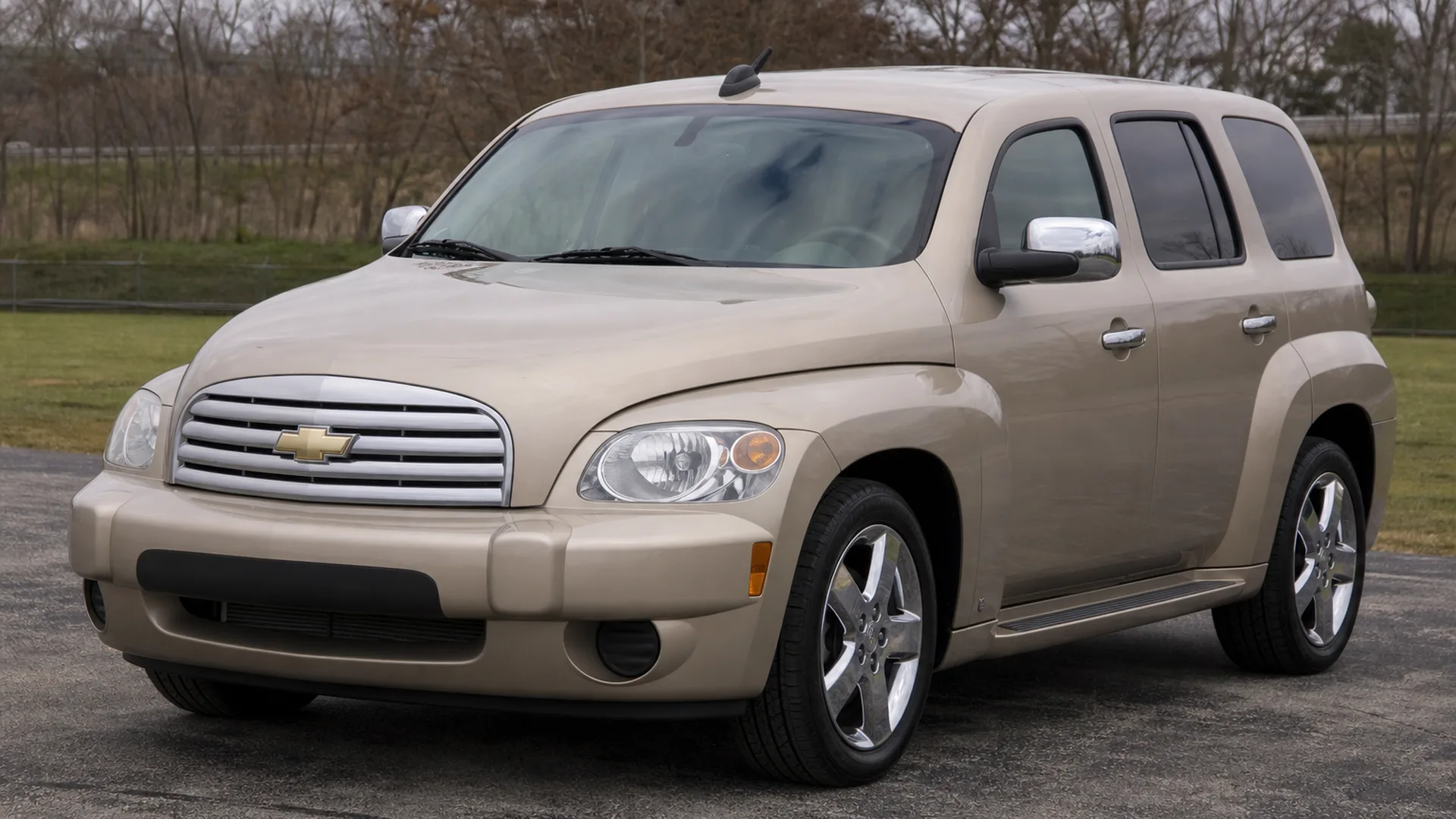
When GM rolled out the Chevy HHR in 2006, it looked like a winning bet. Designer Bryan Nesbitt—the same guy who penned the PT Cruiser—crafted this retro-styled compact wagon to capture that 1940s Suburban vibe. With 63 cubic feet of cargo space, reasonable fuel economy around 24-27 mpg, and a starting price under $17,000, the HHR attracted 93,000 buyers in its first year alone.
But here’s the thing: GM pulled the plug after just five years. Over 700,000 HHRs hit the road between 2006 and 2011, yet production ended in May 2011. Why the short run? Because serious problems kept surfacing—power steering that could quit mid-drive, an ignition switch defect that killed the engine and airbags, and door handles that snapped off and trapped people inside. This guide breaks down which HHR years you should skip entirely and which might be tolerable if you know what you’re getting into.
How we rated the best and worst Chevrolet HHR years
We pulled complaint data straight from the NHTSA database, where 2007 alone racked up more than 550 complaints—the highest count of any HHR year. We also reviewed over 30 official GM recalls spanning every model year from 2006 through 2011, including the massive ignition switch recall that affected 2.6 million vehicles and the electric power steering recall covering 1.3 million cars (including 2009-2010 HHR non-turbo models). IIHS safety rating showed “Good” frontal impact scores but only “Acceptable” side impact marks.
Beyond government records, we combed through owner forums like chevyhhr.net, Consumer Reports reliability ratings, and Kelley Blue Book reviews. We also tracked real-world repair costs and parts availability since production stopped. The ignition switch scandal alone resulted in $900 million in settlements and compensated 77 death claims and 141 injury claims. GM knew about that defect as early as 2003 but didn’t act until 2014—eleven years later.
Shopping for a used Chevrolet?
 Ask a Mechanic about your Chevrolet →
REREV may earn a commission if you sign up through this link. Learn more.
Most Common Chevrolet HHR Problems
1. Engine and Timing Chain Troubles
The 2.4-liter Ecotec engine can develop a nasty timing chain tensioner problem. You’ll hear a rattling sound on cold starts, which means the chain might be loose enough to skip or break. GM issued a revised tensioner (part #12608580), but if yours hasn’t been updated, expect a repair bill between $1,000 and $1,500. Timing chain stretch also pops up between 50,000 and 100,000 miles, causing rough idle, poor fuel economy, and check engine lights. Replacement runs from $989 to $1,251.
Variable Valve Timing solenoids fail too, triggering rough running and stalling. Each solenoid costs $200 to $400 to replace. Coolant system issues round out the list—GM recommends flushing every 150,000 miles, but owners find they need it every 60,000 to prevent heater core clogs. A heater core replacement means pulling the entire dashboard, so budget $800 to $1,200.
2. Power Steering Failures (Critical Safety Risk)
This is the HHR’s scariest defect. The electric power steering can cut out completely while you’re driving, leaving you wrestling a locked-up wheel. In 2008 alone, 294 NHTSA complaints cited sudden steering loss at an average mileage of 76,974. The 2007 model year saw over 200 similar reports. GM recalled 2009-2010 non-turbo models, but plenty of other years experienced the same failure. Owners describe the steering clicking on and off through corners, causing the wheel to jerk wildly.
One driver said, “Lost power steering intermittently for six years. Tried to have it fixed several times, spent lots of money—problem won’t go away. Extremely dangerous.” Another reported, “Power steering shut down while driving. I turned off the engine, waited a minute, restarted it—worked. Traveled one block and it shut down again. Repeated this four times before getting home. Only 69,510 miles on it.”
Replacing the EPS motor costs $605 to $900, but even after repair, some people say the problem comes back. Canada issued broader recalls than the U.S., leaving many American HHRs with a known hazard still on the road.
3. The Ignition Switch Scandal
Every single HHR from 2006 to 2011 got caught in GM’s ignition switch recall. A heavy keyring or rough roads could shift the switch from “run” to “accessory,” shutting off the engine and disabling the airbags. Initially, GM acknowledged 13 deaths. Later, the victim compensation fund paid out for 77 deaths and 141 injuries. GM knew about the problem in 2003—it would have cost just 90 cents per vehicle to fix—but waited until 2014 to issue the recall.
If you own or buy an HHR, keep only the ignition key on the ring. Remove keychains, decorations, and extra keys. Check your VIN at a GM dealer to confirm the recall was completed.
4. Transmission and Electrical Woes
The 4T45-E automatic transmission can slip, slam into gear violently, or fail outright. Owners report transmission fluid turning black with metal flakes—one person described it as “tar-like.” GM replaced one owner’s transmission, only for it to fail again three days later. A rebuild or replacement runs $2,500 to $4,000. Shift assemblies also break, leaving the car stuck in park. That repair costs $200 to $500. Pressure control solenoids and the transmission control module (TCM) can fail too, with prices ranging from $70 to $1,200 depending on the part.
Electrical gremlins include Body Control Module (BCM) failures causing no-start conditions and random malfunctions ($600 to $1,000), instrument cluster failures ($400 to $700), and throttle body problems ($300 to $600). Even the gas cap can fail, triggering EVAP codes—a cheap $20 to $50 fix, but annoying all the same.
5. Door Handles and Water Leaks
Here’s a problem that sounds minor until you’re trapped. The plastic interior door handles snap off on both the driver and passenger sides. In an accident or emergency, you can’t get out. Electric windows won’t work if power is lost, so broken handles become a serious safety issue. GM won’t sell you just the handle—you have to buy the entire door panel for $275 to $350 per door. CarComplaints.com logged 23 door handle complaints for 2006 alone.
Water leaks are common too. The driver’s side floor can soak from front to back, ruining carpet and draining electrical components. Sunroof drain hoses fail and disconnect. Short windows and thick roof pillars also create dangerous blind spots, making lane changes and backing up harder than they should be.
Which Years to Avoid
Stay Away Completely: 2006, 2007, and 2008
2006 was the launch year, bringing all the usual first-year bugs plus six recalls. Door handles broke right away, and the Body Control Module caused electrical chaos. NHTSA received over 400 complaints covering steering, electrical systems, and airbags. Major repairs within the first 100,000 miles typically ran $2,000 to $5,000. One owner said, “Both front door handles broke off. Couldn’t get out after an electrical issue—trapped in the car for several minutes.”
2007 stands out as the worst HHR year. NHTSA logged 550+ complaints, including 17 crashes linked to vehicle defects. Five recalls hit this model year, including the ignition switch. Power steering failures reached crisis levels, with over 200 reports of sudden loss while driving. One complaint read, “Appears to be related to electric power steering system design flaw. Frequently clicks on and off several times going through corners, causing wheel to rotate wildly—has almost caused me to crash several times.”
2008 kept the problems rolling with 294 steering complaints and 91 electrical system complaints. The SS Turbo model debuted, adding turbocharged complexity to an already troubled platform. Consumer Reports specifically called out the “unresponsive automatic transmission.” Five recalls affected this year too. Repair costs often topped $3,000 to $5,000 per incident.
Extreme Caution: 2009
GM’s ignition switch scandal peaked with the 2009 model. The electric power steering recall covered 2009-2010 non-turbo HHRs as part of a 1.3-million-vehicle campaign, but turbo models weren’t included despite similar complaints. Transmission problems emerged more frequently—fluid leaks, violent jerking, and complete loss of forward gears. Parts delays became common as GM focused on newer models. Five recalls hit 2009, and some repairs required multiple attempts before the problem stayed fixed (if it ever did).
The Least-Bad Option: 2010-2011
If you absolutely must own an HHR, look at 2010 or 2011. These final production years had four and three recalls respectively—still problematic, but fewer than earlier models. Some owners report hitting 200,000 to 350,000 miles with diligent maintenance. Side curtain airbags became standard, improving safety. GM phased out its badges mid-2010, switching to Chevrolet bowties only. The SS model ended after 2010.
Production wrapped up in May 2011 because the Cobalt platform was being replaced by the Cruze. That means parts availability is shrinking. Many components are already discontinued, forcing you to rely on aftermarket suppliers of varying quality.
What to Do If You’re Buying a 2010 or 2011
First, verify every recall was completed. Check the VIN at a GM dealer to confirm the ignition switch, power steering, and all other recalls are done. Budget $2,000 to $3,000 for anticipated repairs, or buy an extended warranty. Remove everything from your keyring except the ignition key to reduce the risk of the ignition defect.
Get a pre-purchase inspection from a mechanic who knows the GM Delta platform. They should check:
- Timing chain for cold-start rattles
- Power steering by doing full lock-to-lock turns in a parking lot and at highway speed
- All four door handles for cracks or looseness
- Transmission shifting smoothness in every gear
- Electrical systems including the BCM, instrument cluster, windows, and locks
- Floor carpets and trunk for dampness or water damage
- Sunroof drains if equipped
Make sure you see complete service records. A 30-minute test drive minimum is smart—include highway speeds, tight corners, and parking maneuvers to stress-test the power steering.
Better Alternatives to Consider
Honda Element (2003-2011)
The Element offers similar boxy styling but with Honda’s K-series engine, which routinely hits 300,000 miles. Suicide doors make loading cargo easier, and the flat floor beats the HHR’s cargo area. Maintenance costs average $350 per year versus the HHR’s $600-plus. Resale value holds stronger—Elements retain about 45% of their value compared to the HHR’s 30%. Parts are available nationwide at any Honda dealer.
Scion xB (2004-2015)
Built on Toyota’s reliable bones, the xB regularly exceeds 250,000 miles. Real-world fuel economy hits 28 to 31 mpg combined, beating the HHR’s 18 city and 27 highway. The design is simpler with fewer electronic gremlins. Insurance costs less because there aren’t major safety recalls hanging over it. Parts are easy to find at Toyota dealers.
Mazda5 Minivan (2006-2015)
If you need space, the Mazda5 gives you sliding doors and three rows of seats for six passengers. Safety ratings top the HHR across the board. Mazda’s reliability ratings sit above average for compact vans. Highway fuel economy reaches 28 mpg, and repair costs run lower over the vehicle’s life.
Kia Soul (2010-Present)
The Soul matches the HHR’s boxy personality but adds modern reliability and a 10-year/100,000-mile powertrain warranty (transferable on used models). Fuel economy hits 27 to 31 mpg combined. Because it’s still in production, parts support is excellent. Insurance costs stay reasonable, and resale value beats the HHR.
Real-World Cost Comparison
Let’s say you buy a 2010 HHR for $6,000 to $10,000 today. Annual maintenance runs $600 to $1,000. Over five years, expect $2,000 to $3,000 in major repairs. Add fuel costs at 24 mpg combined (about $2,000 per year at $4 per gallon) and insurance premiums 10-15% higher due to recalls. Total five-year ownership: $18,000 to $25,000. After five years, you might get $2,000 to $3,000 at resale—a 70% depreciation hit.
Now compare that to a Honda Element you buy for $8,000 to $12,000. Annual maintenance drops to $350 to $500. Major repairs over five years: $800 to $1,200. Fuel costs run slightly higher at 22 mpg ($2,182 per year), and insurance stays at standard rates. Total five-year ownership: $15,000 to $20,000. Resale value after five years: $5,000 to $7,000—only 45% depreciation.
The Element saves you $3,000 to $5,000 over five years while providing better reliability and safety. A single HHR transmission replacement at $3,000 wipes out any savings from the lower purchase price. When you sell, the Element is worth $2,000 to $4,000 more.
Final Thoughts
Skip the 2006, 2007, and 2008 HHRs entirely. They have the highest complaint counts, the most dangerous power steering failures, and the worst electrical problems. The 2007 alone logged 550+ NHTSA complaints and was involved in 17 crashes. Handle 2009 with extreme caution—it sits at the center of the ignition switch scandal and power steering recall.
If you insist on an HHR, only consider 2010 or 2011. Even then, verify all recalls are done, get a thorough inspection, and keep $2,000 to $3,000 set aside for repairs. Parts are getting harder to find since production ended in 2011.
Honestly, you’re better off with a Honda Element, Scion xB, Mazda5, or Kia Soul. Each one costs about the same used but delivers better reliability, lower repair costs, and stronger resale value. A used Element with 100,000 miles will outlast an HHR with 50,000 miles—and you won’t be stuck replacing $350 door panels just so you can get out of your own car.
With 550+ NHTSA complaints for 2007, GM’s $900 million in ignition switch settlements covering 77 deaths, and 294 steering failures for 2008, the data is clear. GM discontinued the HHR after only five years for good reasons. Don’t ignore those red flags when safer, more dependable alternatives are sitting right next to it on the used lot.