
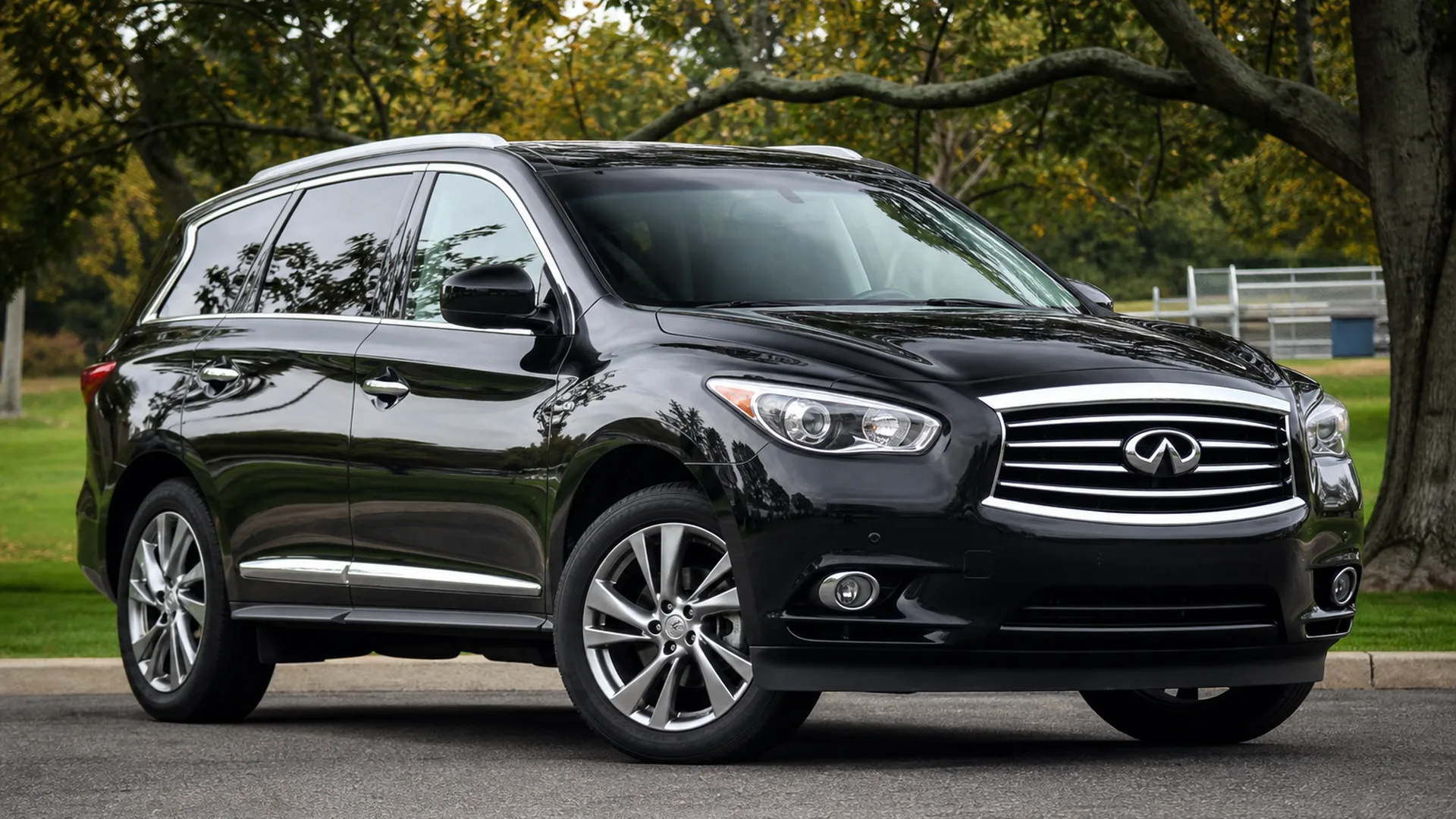
Buying a used luxury SUV? The Infiniti JX35 might catch your eye with its premium styling, spacious three-row seating, and loaded feature list at a tempting price point. But here’s what dealerships won’t tell you: the 2013 launch year is plagued by transmission failures, airbag recalls, and timing chain issues that can drain your wallet fast. This guide breaks down exactly which JX35 years to skip, what problems you’re likely to face, and which alternatives will actually get your family where they need to go—without constant repair bills.
How we rated the best and worst Infiniti JX35 years
We didn’t rely on marketing materials or showroom promises. Our team analyzed official NHTSA recall databases, focusing on critical safety campaigns like 13V445000 (ABS reprogramming), 13V139000 (brake bracket fractures), and 14V138000 (airbag sensor failures). We cross-referenced thousands of owner complaints on CarComplaints, RepairPal, and Edmunds to identify patterns in real-world failures.
We studied the CVT class-action lawsuit documents that forced Infiniti to extend transmission warranties from 6 years/70,000 miles to 8 years/94,000 miles. We reviewed Consumer Reports reliability scores, J.D. Power dependability rankings, and Infiniti’s own technical service bulletins on everything from timing chain rattles to sun visor failures. We even combed through owner forums where people share brutal honesty about $5,000 transmission replacements and multiple warranty visits.
The result? A clear picture of which model years will treat you right and which ones will leave you stranded at the mechanic’s shop.
Most Common Infiniti JX35 Problems
1. The CVT Transmission Nightmare
Let’s start with the elephant in the garage: Nissan’s continuously variable transmission. This is hands-down the JX35’s biggest weakness. Owners report shuddering, juddering, and hesitation when accelerating—especially that strange “rubber-band” sensation between 20 and 40 MPH. Some drivers experienced complete loss of drive where the engine revs freely but the wheels don’t turn until you restart the vehicle.
Early 2013 models saw transmission replacements at shockingly low mileage. One owner’s brand-new JX needed both a torque converter and a full CVT replacement under warranty after severe shaking made the vehicle undrivable. Outside warranty coverage, you’re looking at $4,000 to $5,500 for a rebuilt CVT plus installation labor.
Infiniti issued transmission control module software updates and eventually extended the warranty as part of a settlement—but that extension only applied to 2013–2014 models because those were the problem children. If you’re test-driving a used JX35, insist on documentation proving the CVT software was updated or the unit was replaced. This single issue has defined the JX35’s reputation more than any other.
2. Engine Problems: Timing Chain Rattle
Fire up a cold JX35 and listen carefully. Hear a metallic rattle or tapping from under the hood? That’s the timing chain guides and tensioners wearing out prematurely. The 3.5L VQ35 V6 is generally solid, but early timing chain components degrade faster than they should—sometimes by 60,000 miles.
Ignore that rattle and you risk timing chain failure, which can destroy your engine. Infiniti released revised guide rails and tensioners to address this, but the repair runs $2,500 to $3,000 because of the intensive labor involved. The timing chain sits deep in the engine, requiring technicians to disassemble substantial portions of the front end.
There’s also a quirky idle issue: after cleaning the throttle body to remove carbon buildup, some JX35s start idling erratically or surging. The engine computer miscalculates airflow once the carbon is gone, leading to high idle until it relearns the correct settings. The fix is either a proper ECU reset or simply avoiding manual throttle plate movement during cleaning.
3. Electrical Gremlins: Airbag Sensors and Dashboard Mysteries
The 2013 JX35’s Occupant Detection System turned out to be a serious safety concern. The sensors in the front passenger seat could incorrectly classify an adult as “empty,” shutting off the airbag entirely. You’d know this was happening when the “airbag OFF” light stayed illuminated with a full-grown passenger sitting right there.
This prompted two separate recalls: 13V069000 to replace faulty sensor hardware and 14V138000 to update the software. Both addressed the same fundamental problem—the system couldn’t reliably detect passengers. Some owners reported the airbag warning light staying on from day one of ownership.
Beyond airbag sensors, the JX35 has typical Nissan electrical reliability with a few exceptions. Random warning lights and unexplained dashboard codes pop up occasionally, requiring dealer scans to diagnose. The battery and alternator hold up fine unless you’re running heavy electronics (rear DVD system, multiple device charging) without driving regularly.
There’s also recall 13V445000 for ABS/traction control reprogramming. The original brake software logic could cause longer stopping distances on rough surfaces during light braking—an ABS module software patch fixed this, but you should verify it was applied.
4. Brakes: Undersized and Fast-Wearing
Here’s something Infiniti quietly admitted: the JX35’s brake components are undersized for a three-row SUV. Front brake pads need replacement as early as 20,000 to 30,000 miles. Rear pads often wear even faster—some owners reported rear pads down to 3mm remaining at just 21,000 miles.
This rapid wear leads to squeaking, grinding noises, and reduced stopping power if you don’t stay on top of maintenance. Factor in more frequent brake jobs than you’d expect from a luxury vehicle, and use quality pads and rotors to maximize longevity.
There was also recall 13V139000 for improperly cast front brake torque members (caliper brackets). These could crack and allow the caliper to shift, potentially contacting the wheel—a dangerous failure mode that Infiniti addressed by inspecting and replacing affected brackets.
Some owners also report rotor warping that causes steering wheel vibration during highway-speed braking, plus occasional ABS and traction warning lights traced to wheel speed sensors. The braking system works adequately once you refresh pads and rotors, but plan on shorter service intervals compared to lighter vehicles.
5. Suspension Sensitivity
The JX35 rides comfortably when everything’s balanced and aligned, but it’s picky about suspension condition. Even minor wheel imbalances or worn bushings cause vibrations and steering shimmy that you’d barely notice in other SUVs. Infiniti issued technical service bulletins recommending proper road-force balancing and checking for out-of-round wheels or tire cupping.
Owners report rear clunking when turning (often worn stabilizer links or bushings) and front-end rattles traced to loose strut mount trim or unlubricated steering stops—both relatively easy fixes. The suspension hardware itself (struts, control arms, tie rods) has average durability, but you need to stay vigilant.
If you experience persistent highway vibrations, have the tires road-force balanced and inspect for bent rims, bad wheel bearings, or worn bushings. The JX35 will reveal these problems more readily than many competitors. The electric power steering is light and smooth, if a bit numb, but don’t let early suspension wear symptoms slide.
6. A/C and Climate Control Issues
The JX35’s tri-zone climate system develops problems as it ages. Weak cooling or warm air from certain vents usually points to leaking A/C pipe assemblies—the refrigerant lines can develop pinhole leaks that slowly drain the system. Infiniti issued a service bulletin covering replacement of certain pipe assemblies prone to this failure.
Another culprit is a sticky expansion valve that prevents proper cooling at idle. Technicians note that JX/QX60 A/C problems typically involve low refrigerant from leaks or a bad expansion valve. One early owner mentioned HVAC fan noise after just two months of ownership.
If the climate control freezes or becomes unresponsive, disconnecting the battery for a few minutes often resets the system—pointing to occasional electronic glitches rather than mechanical failures. Fixes range from replacing a $5 O-ring to full compressor replacement on higher-mileage examples. Budget a few hundred dollars for potential A/C repairs, more if the compressor clutch fails, especially on 8- to 10-year-old models in hot climates.
7. Interior Tech: Sun Visors and Infotainment Glitches
The most common interior complaint is almost comically low-tech: broken sun visors. The driver’s sun visor hinge is weak, and multiple owners reported visors drooping or snapping off entirely. “Sun visor broken” ranks as the top-reported problem on CarComplaints for the 2013 JX35. Infiniti even issued a TSB about replacing the visor with an improved part.
For high-tech components, some JX35s experienced frozen navigation screens, unresponsive audio systems, or the entire center stack (audio, climate controls, backup camera) going dark. A hard reset—battery disconnect or fuse pull—usually restores functionality.
There was a software update to address backup camera issues and ensure compliance with federal safety rules (Infiniti participated in a 2018 recall campaign to fix rear camera settings). Bluetooth connectivity is generally solid, though some owners mention having to reboot the system to fix audio stuttering.
The JX35’s advanced driver aids (lane departure warning, collision alerts on Tech Package models) sometimes threw false warnings. Infiniti updated this software in later QX60 models. Make sure firmware updates for navigation, infotainment, and safety systems were applied by a dealer.
2013 Infiniti JX35: The Year to Absolutely Avoid
If you take away one thing from this guide, make it this: skip the 2013 JX35 entirely. This is the only model year sold under the “JX35” name before Infiniti rebranded it as QX60 for 2014, and it accumulated the highest complaint count and the most severe issues.
Eight Recalls Tell the Story
The 2013 JX35 was hit with up to eight separate recalls covering critical safety systems:
Recall 12V398000 (August 2012): Misrouted fuel transfer tube in the gas tank could cause the fuel gauge to read incorrectly high, leading to unexpected stalling when the tank actually ran empty.
Recall 13V069000 (2013): Out-of-spec Occupant Detection System sensor mats that could permanently suppress the passenger airbag.
Recall 13V139000 (April 2013): Improperly cast front brake caliper brackets that could fracture, allowing the caliper to shift and contact the wheel.
Recall 13V445000 (October 2013): ABS/traction control logic reprogramming to prevent longer stopping distances on rough surfaces during light braking.
Recall 14V138000 (2014): Widespread OCS software fix for airbag sensors across multiple model years.
Any 2013 JX35 you consider must have documentation proving all recall work was completed—especially safety-critical items. Check the VIN against NHTSA’s database before handing over money.
Transmission Failures Sparked a Lawsuit
CVT failures in 2013 are extensively documented, with multiple owners reporting replacements under warranty. This contributed to a class-action lawsuit that resulted in the extended CVT warranty covering 2013–2014 models. It’s not uncommon to find 2013 JX35s that needed two transmission replacements—one early on and possibly another around 60,000 to 80,000 miles.
One forum user called their 2013 “my worst nightmare,” listing repairs that included the fuel gauge sensor, rattling sunroof, and a complete transmission—all before 70,000 miles. Many repairs were covered under warranty, but that doesn’t help you if those warranties have expired and you’re buying used.
First-Year Quality Issues Everywhere
Beyond powertrain problems, 2013 models dealt with first-year bugs across the board. The airbag light staying on from day one, failing backup camera displays, and those infamous broken sun visors. Even paint quality was questionable—some owners noted thin paint prone to chipping and weatherstripping that came loose.
Consumer Reports gave the 2013 JX35 a below-average reliability rating, specifically flagging transmission and electronics as trouble spots. RepairPal data shows 2013 had worse average annual repair costs and more frequent unscheduled repairs than later QX60 years.
The extended CVT warranty applying only to 2013–2014 builds tells you everything: Infiniti acknowledged these were the problem years. The company renamed the model after 2013 and implemented running changes—transmission control module updates in mid-2014, stronger brake components, and software patches throughout the lineup.
If you find a 2013 JX35 with complete service records showing all recalls done and major components replaced, you might be okay—but you’re still gambling on a vehicle with the worst track record in its generation. You’ll almost certainly have a better experience with a 2014 or later QX60, and a significantly better one with 2016 or newer.
Better JX35/QX60 Years Worth Buying
If you love the QX60’s comfort and features but want to avoid constant repairs, aim for mid-to-late generation years. Infiniti continuously improved the model after that rough 2013 launch, and reliability jumped considerably by the mid-2010s.
2015 QX60: The Bridge Year
By 2015, Infiniti had squashed many early bugs. CarComplaints shows only 9 total complaints for 2015 compared to 17–19 for 2013–2014, and most were minor—exterior trim issues and a few lingering transmission quirks. The CVT received new programming that largely eliminated the infamous judder.
Some analysts still suggest avoiding 2015 because of remaining transmission and accessory faults, but real-world data shows 2015 models performing significantly better than 2013–2014. If budget constraints push you toward a 2015, make sure the transmission feels smooth during test drives. Ideally, it may have already received a torque converter or valve body replacement under warranty.
Think of 2015 as a transitional year—better than the early disasters but not quite as refined as what came next.
2016 QX60: The Sweet Spot
The 2016 model year marks a clear turning point. It received a mid-cycle refresh with mechanical tweaks and updated styling, and problem rates dropped dramatically. Only 5 complaints appear on record, mostly minor issues like one A/C problem and one engine sensor glitch.
By 2016, the CVT hardware and software had been refined through multiple iterations. Many problematic earlier units had been weeded out or fixed under warranty. The 2016 model year fell outside the class-action window, meaning these CVTs were generally more robust from the factory.
Watch for air conditioning or heater problems—a few 2016s had reports of bad blower motors or condensers—but these were isolated cases and not expensive to repair. The 2016 QX60 offers the best balance of affordability and reliability for used buyers. You get updated styling, nearly all important fixes implemented, and lower prices than very recent models.
2018–2020 QX60: Peak Reliability
If your budget allows a newer used model, the 2018–2020 QX60 years represent the model at its most dependable. These late-cycle models benefit from all mid-cycle improvements and seven years of refinement.
Owner complaint data shows 2018 and 2019 models with notably low issue rates. These consistently appear on “excellent used buy” lists because they have minimal problems compared to earlier years. You might encounter a stray check-engine light or Bluetooth glitch, but nothing approaching the transmission drama of 2013.
The 2019 QX60 introduced a new direct-injection V6 making 295 hp—a nice power bump. There were a few reports of engine sensor gremlins on 2019s and one recall for a fuel pump issue affecting certain Nissan/Infiniti V6s, but these issues are much less severe and far rarer than early-model problems.
By 2019, Infiniti had tweaked the CVT further, and most examples are holding up well. Many 2018–2020 models are still under powertrain warranty or recently came off coverage. The 2020 was the final year of that generation, benefiting from the full evolution of improvements—it’s among the best, though often pricier on the used market.
What About 2014 and 2017?
The 2014 QX60 is better than 2013 but still carries baggage. Transmissions were still being sorted out, and it logged the most complaints of any QX60 model year with 19 issues recorded. The 2014 model year essentially renamed the JX35 without fully solving its problems.
The 2017 QX60 saw an uptick in problems, possibly related to the new direct-injected engine introduced mid-year and some build quality issues. Multiple sources flag 2017 for extensive engine troubles, transmission faults, A/C failures, and exterior issues. It had more engine complaints than 2016 or 2018.
If choosing between a 2016 and 2017, the 2016 is the safer reliability bet. We generally recommend skipping 2014