
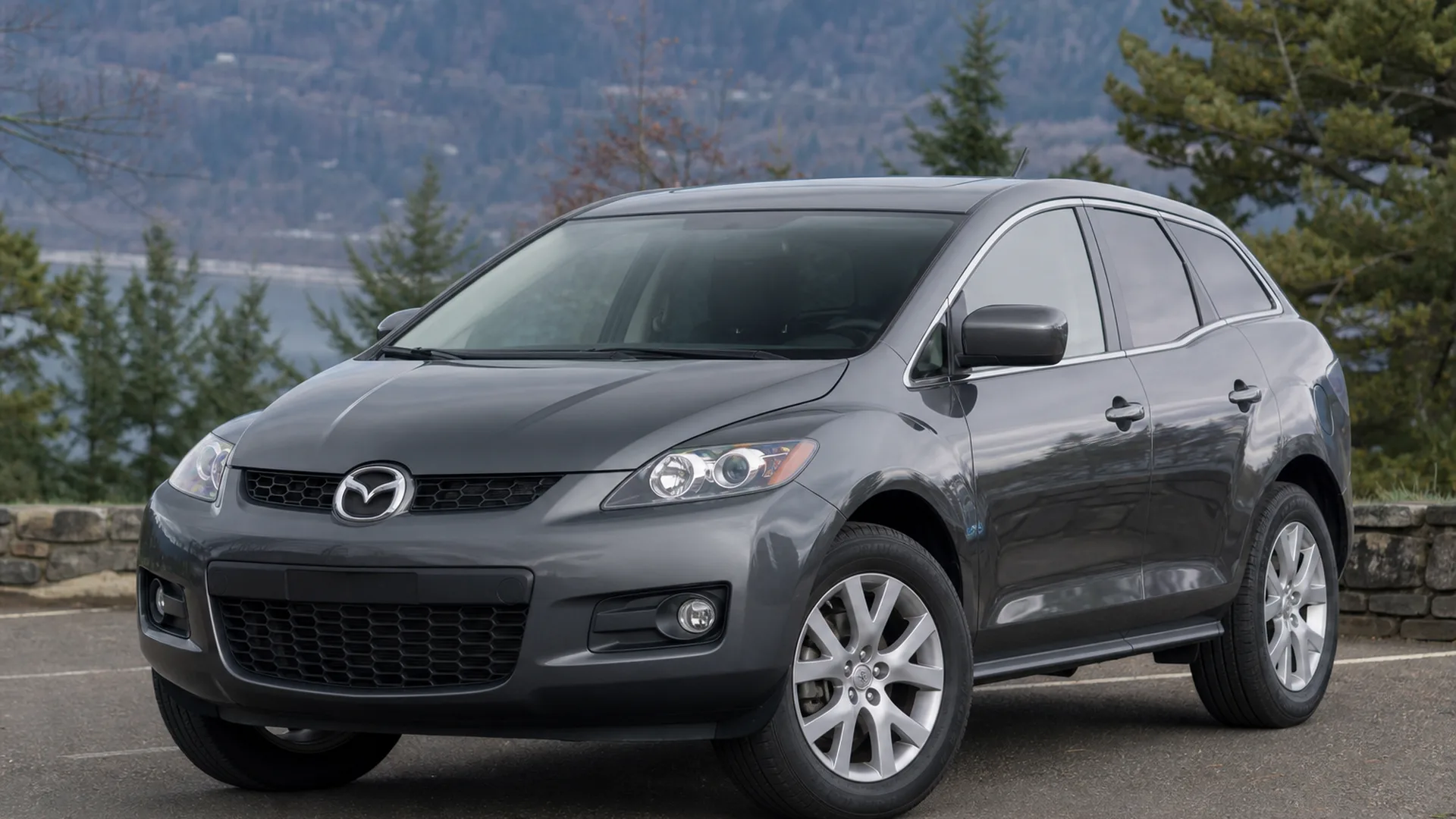
When Mazda launched the CX-7 in 2007, it arrived with real swagger. You got a turbocharged 2.3L engine borrowed from the Mazdaspeed3, sharper handling than most SUVs, and styling that looked ready to carve corners instead of cruise parking lots. For a few years, it seemed like Mazda had cracked the code on making a practical crossover that still felt fun. Then the bills started arriving. Early CX-7s became infamous for turbocharger meltdowns, stretched timing chains, and repair estimates that made even seasoned mechanics wince. This guide walks you through which Mazda CX-7 years you should skip, which ones might be worth a shot, and what to check before you hand over any cash.
How We Built This Guide
We pulled data from NHTSA‘s recall database, Transport Canada’s safety notices, and CarComplaints.com‘s owner-reported problems. RepairPal provided repair-cost context, and we cross-checked patterns against Mazda owner forums to see where statistical spikes matched real-world breakdowns. The goal: separate the model years with fixable quirks from the ones that’ll drain your wallet before you hit 100,000 miles. Every claim here traces back to official records or verified owner reports—no guesswork, no marketing spin.
The Problems That Define the CX-7
1. Engine Failures: Turbo, Timing Chain, and Oil Sensitivity
The 2.3L turbocharged engine was supposed to be the CX-7’s party trick. Instead, it became the reason CarComplaints slapped a “avoid like the plague” label on the 2007 model. Timing chain stretch shows up around 70,000–80,000 miles, starting with a metallic rattle at cold start that sounds like marbles in a can. Ignore it, and the chain can slip enough to smash valves into pistons—one 2007 owner faced a $8,000 rebuild after the VVT actuator failed and the chain let go.
Turbocharger failures hit almost as hard. Owners report squealing, blue smoke, and a sudden inability to accelerate past 20 mph. Replacement runs $2,500–$3,000 if you catch it early; if the turbo grenades and sends metal shards through the oil system, you’re looking at $8,000–$9,000 for a new engine. Mazda never issued a recall, so every repair came out of someone’s pocket.
Oil quality matters more here than on most engines. The turbo runs hot, and sludge buildup clogs the oil feed lines. One 2008 owner’s mechanic found sludge packed throughout the engine during a timing chain job—the car needed a full $5,000 engine swap because internal damage had already spread. If you’re eyeing a used CX-7 with the turbo, missing oil-change records are a deal-breaker.
Mazda added a naturally aspirated 2.5L engine in 2010 for base trims, and that motor sidesteps most of these headaches. By 2012, even the turbo models had revised internals that cut down on failures. But 2007–2010 turbo CX-7s? Treat them like ticking time bombs unless you see proof of fresh chains, new turbos, and religious 4,000-mile oil changes.
2. Transmission Quirks and Software Bugs
The six-speed automatic doesn’t fail as often as the engine, but it has its moments. Every year from 2007 to 2012 shows complaints about harsh shifts, especially when the transmission warms up. Mazda labeled the fluid “lifetime,” but the software tuning was sloppy at launch. The transmission control module would hunt between gears or delay downshifts, creating a lurching feel in city traffic.
Mazda released software updates to smooth things out, so if a test drive feels like the transmission is confused, ask if the dealer ever flashed the TCM. Some 2010–2011 owners reported the transmission dropping into third gear on the highway and staying there until they restarted the car—a failsafe mode triggered by an internal fault. Mechanical valve-body failures can cause slipping, too, and those repairs mean pulling the whole transmission for a rebuild.
A handful of independent shops recommend changing the “lifetime” fluid around 60,000 miles with Mazda-spec ATF. It’s not required, but fresh fluid seems to reduce shudder. If you buy a CX-7, test it on a long drive after it’s fully warmed up. Any hesitation, flare, or clunk is your cue to walk.
3. Electrical Gremlins and TPMS Headaches
Electrical problems on the CX-7 range from annoying to genuinely concerning. Some 2007–2009 owners dealt with flickering dash lights, gauges that would drop to zero while driving, and radios that cut out mid-song. A loose ground cable fixed one case; an ignition-switch fault explained another. These issues are harder to diagnose than mechanical failures because they come and go.
The tire pressure monitoring system corrodes easily in salt-belt states, triggering constant warnings or even causing slow air leaks from the valve stem. Mazda didn’t recall it, so replacement sensors became an owner expense. And like many mid-2000s cars, the CX-7 got caught up in the Takata airbag recall. By 2023, NHTSA issued “do not drive” warnings for any remaining CX-7s with unrepaired Takata inflators. If you’re checking out a used one, run the VIN through NHTSA’s recall site before you go anywhere near a test drive.
4. Front Suspension Ball Joints: The Safety Recall You Can’t Ignore
This one’s serious. Road salt can corrode the front lower control arm ball joints on every CX-7 made between 2007 and 2012. When the ball joint separates, you lose steering control—no warning, just sudden failure. Mazda recalled about 190,000 vehicles in the U.S. (NHTSA campaign 16V-593) and another batch in Canada (recall 2016394) to replace the control arms with corrosion-resistant parts.
If you’re looking at a used CX-7, confirm with a Mazda dealer that this recall was completed. They’ll check by VIN. If it wasn’t done, Mazda will still fix it for free, but you don’t want to be the one driving when a ball joint lets go. This recall alone is a non-negotiable checkpoint—everything else is secondary.
5. AC Compressor Failures in Early Models
The 2007 CX-7 earned a reputation for AC compressors that seized at low mileage, sometimes as early as 30,000–40,000 miles. When the compressor locks up, it can snap the serpentine belt, which also drives the alternator and water pump—one owner’s belt failure stalled the engine on a busy road. Replacement cost around $1,500.
Mazda redesigned the AC system for 2008, which helped, but some 2008 models still had compressor failures within 60,000 miles. By 2009, complaints dropped off. If you’re test-driving a 2007 or 2008, crank the AC to max and listen for grinding or squealing. If the compressor was already replaced, that’s actually good news—it probably got an updated part.
6. Infotainment: Minor Issues Compared to the Engine
Tech problems on the CX-7 rarely made headlines. Some owners reported radios that would lose power, Bluetooth that wouldn’t pair, or navigation clocks that never adjusted for daylight saving time. Electrical instability (weak battery, poor grounds) caused most of these glitches. Replacing a blown fuse or swapping in a new head unit fixed the rest.
The backup camera and keyless entry systems didn’t show widespread failure patterns. If you’re buying used, test every button—radio, climate controls, power windows—but don’t lose sleep over tech issues. They’re cheap to fix compared to a $5,000 engine rebuild.
Model Years to Skip Completely
2007: The Worst Year by a Mile
CarComplaints.com logged 786 complaints and five recalls for the 2007 CX-7. Timing chain stretch dominated the complaint list, followed closely by turbo failures. Owners who kept their cars past 80,000 miles often faced repair quotes between $6,000 and $9,000. Mazda issued recalls for engine mounts, AC wiring, and overheating risks, but never for the chain or turbo—the two problems that cost the most.
If you see a 2007 CX-7 listed cheap, assume it’s cheap for a reason. Unless someone hands you a stack of receipts proving a fresh engine with updated parts, walk away.
2008: Slightly Better, Still Risky
The 2008 carried over most of 2007’s mechanical DNA, which meant it carried over most of 2007’s problems. CarComplaints tracked 296 complaints—fewer than 2007, but still enough to earn another “avoid” label. Timing chains stretched, turbos failed (sometimes within the first 6 months), and oil sludge kept destroying engines.
Mazda did improve the AC compressor design for 2008, so at least that failure rate dropped. But engine reliability stayed dicey. One owner’s 2008 developed a ticking noise that turned out to be a stretched chain; the teardown revealed so much sludge that the mechanic recommended scrapping the engine. Total cost: $5,000.
Only consider a 2008 if you find one with documented engine work and a price low enough to cover future repairs.
2010: The Turbo Models Are Still Trouble
Mazda refreshed the CX-7 for 2010, adding the 2.5L non-turbo engine and updating the interior. But if you bought a 2010 with the turbo, you inherited the same timing chain and turbo failure risks. CarComplaints documented 244 complaints, including a dramatic case where a 2010 lost all power on the highway and belched smoke—the turbo had exploded without warning.
If you’re shopping 2010, the non-turbo 2.5L models (branded as “i” trims) are safer bets. They skip the turbo and timing chain headaches entirely. But Grand Touring trims and turbo-equipped variants? Treat them the same way you’d treat a 2007: assume major repairs are coming unless you see proof they’ve already been done.
2009: Better, But Not Safe
The 2009 sits in a weird middle ground. CarComplaints shows only 90 total complaints—far fewer than 2007–2008—and some reviewers even call it the most reliable early CX-7. Mazda didn’t announce any major changes, so the drop in complaints might reflect lower sales volume or quiet improvements on the factory floor.
Still, 2009 models can suffer timing chain stretch and turbo failures. One owner lost power on the highway when the chain stretched and the VVT actuator failed; the dealer quoted $9,000 for the repair. If you find a well-maintained 2009 with service records showing frequent oil changes, it might be worth a gamble—but it’s not a safe pick like the 2012.
Years That Might Be Worth Your Time
2012: The Best of a Flawed Lineup
The 2012 CX-7 is the last year Mazda made it, and it’s the cleanest option if you want one. Complaint numbers are low, and most issues reported were cosmetic (paint chips, interior trim wear). By 2012, turbo models had revised internals that cut down on failures, and many 2012s sold with the 2.5L non-turbo engine.
You’re not going to find many 2012 CX-7s—they’re rare because Mazda was already transitioning to the CX-5. But if you do find one, it’s the safest year to buy. Just confirm the ball joint recall was completed and budget for normal maintenance (brake pads, suspension bushings) on a 12-year-old SUV.
2011: A Close Second
The 2011 benefits from Mazda’s late-stage fixes. Complaint volume dropped, and many buyers chose the 2.5L engine, which improved overall reliability. A small number of 2011 owners reported transmission issues—hard shifts or occasional slipping—but these were outliers, not epidemics.
If you’re comparing a 2011 to a 2012 and the 2011 is significantly cheaper, it’s a reasonable trade-off. Just get a pre-purchase inspection focused on the transmission and any stored engine codes. A clean 2011 with the 2.5L engine can hit high mileage without drama.
2009: Conditional Pick for Budget Shoppers
If your budget forces you into the early years, the 2009 is your best shot. It has fewer reported problems than 2007–2008, and some owners have logged 150,000+ miles without major repairs. But you’re still gambling—timing chains and turbos can fail, just less often.
Only buy a 2009 if:
- You see detailed service records with frequent oil changes
- The seller can prove the timing chain and turbo haven’t been touched (or better yet, were already replaced)
- You budget $2,000–$3,000 for “just in case” repairs
If any of those boxes are empty, skip it.
Regional Differences That Matter
U.S. vs. Canada: Same Problems, More Salt
Canadian CX-7s face all the same mechanical issues as U.S. models, but road salt makes corrosion worse. Transport Canada issued the same ball joint recall (2016394) that NHTSA did in the U.S., and Canadian owners report more rust on exhaust systems, rear wheel wells, and suspension components.
If you’re buying in Canada or any northern U.S. state, put the car on a lift and check the undercarriage. Excessive rust on brake lines or control arms is a red flag. Mazda Canada also didn’t offer any extended warranty for turbo or timing chain failures, so Canadian owners paid out of pocket just like U.S. buyers.
Europe and Diesel Models
Europe got a 2.2L turbo-diesel CX-7 starting in 2009. That engine has its own problems—diesel particulate filter clogs, EGR soot buildup, and oil dilution from excessive regeneration cycles. If you’re importing a European CX-7 or considering one outside North America, know that diesel parts and expertise are harder to find stateside.
Climate Amplifies Specific Problems
Hot climates (Arizona, Texas, Middle East) stress the AC system, making compressor failures more likely. Cold climates (Canada, northern U.S., Northern Europe) accelerate corrosion and put extra load on the turbo during cold starts. A CX-7 from Florida might need a new AC compressor but have zero rust. A Chicago car might have perfect AC but a corroded undercarriage.
Ask where the car lived most of its life, and inspect accordingly.
Pre-Purchase Checklist: What to Check Before You Buy
- Run the VIN through NHTSA and Mazda’s recall portals. Confirm the ball joint recall (16V-593) and Takata airbag recalls were completed.
- Request full service records. Look for oil changes every 4,000–5,000 miles on turbo models. Missing records? Walk.
- Get a pre-purchase inspection from a Mazda specialist. Key items: turbo health (check for oil in intercooler pipes), timing chain noise (listen for cold-start rattle), compression test, transmission behavior, AC performance.
- Check for leaks. Common spots: turbo oil feed/return lines, front timing cover (VVT actuator), transfer case on AWD models, rear differential.
- Test drive when fully warmed up. The transmission should shift smoothly in city and highway driving. Any hesitation, flare, or clunk means expensive trouble.
- Ask about software updates. Mazda issued TSB flashes for the transmission control module and engine computer. Make sure they were applied.
- Budget for repairs or buy an extended warranty. If you’re buying a turbo CX-7 out of warranty, set aside $3,000–$5,000 for potential engine work. Third-party warranties sometimes cover powertrain, but read the fine print—many exclude turbo failures as “wear and tear.”
Better Alternatives to Consider
The CX-7 offers a sporty driving experience, but if reliability matters more, the Mazda CX-5 (launched in 2013) is a smarter buy. Early CX-5s skip the turbo, get better fuel economy, and have a much cleaner track record. Honda CR-V and Toyota RAV4 models from the late 2000s also outperform the CX-7 in long-term reliability—they’re not as quick, but they’ll hit 150,000 miles without needing a new engine.
If you love Mazda’s handling but want something more dependable, the first-gen CX-9 (2007–2015) has a better reliability record than the CX-7, though it’s larger and drinks more gas. Even a Mazda3 or Mazda6 wagon might scratch the same itch with fewer expensive surprises.
Final Verdict
If you want a Mazda CX-7, shop 2012 first, then 2011. The 2012 is the cleanest year, with the lowest complaint rate and the benefit of late-production refinements. The 2011 is a close second and often costs less. If budget forces you into earlier years, the 2009 is the only one worth considering—and only if you see proof of meticulous maintenance.
Skip 2007 and 2008 entirely. They’re disaster zones. The 2010 is risky unless it has the 2.5L non-turbo engine. And no matter which year you buy, confirm the ball joint recall was completed. That’s a safety issue you can’t ignore.
Pay for a pre-purchase inspection. Spend the $150–$200 upfront to save yourself $5,000–$8,000 later. Check the VIN for open recalls. Test the AC. Listen for timing chain rattle. If anything feels off, walk away—there are safer SUVs out there for the same money.
The CX-7 can be a fun daily driver if you get a good one. But the early years are expensive gambles, and the risks are real. Do your homework, trust the data, and don’t let a low sticker price blind you to the repair bills waiting down the road.