
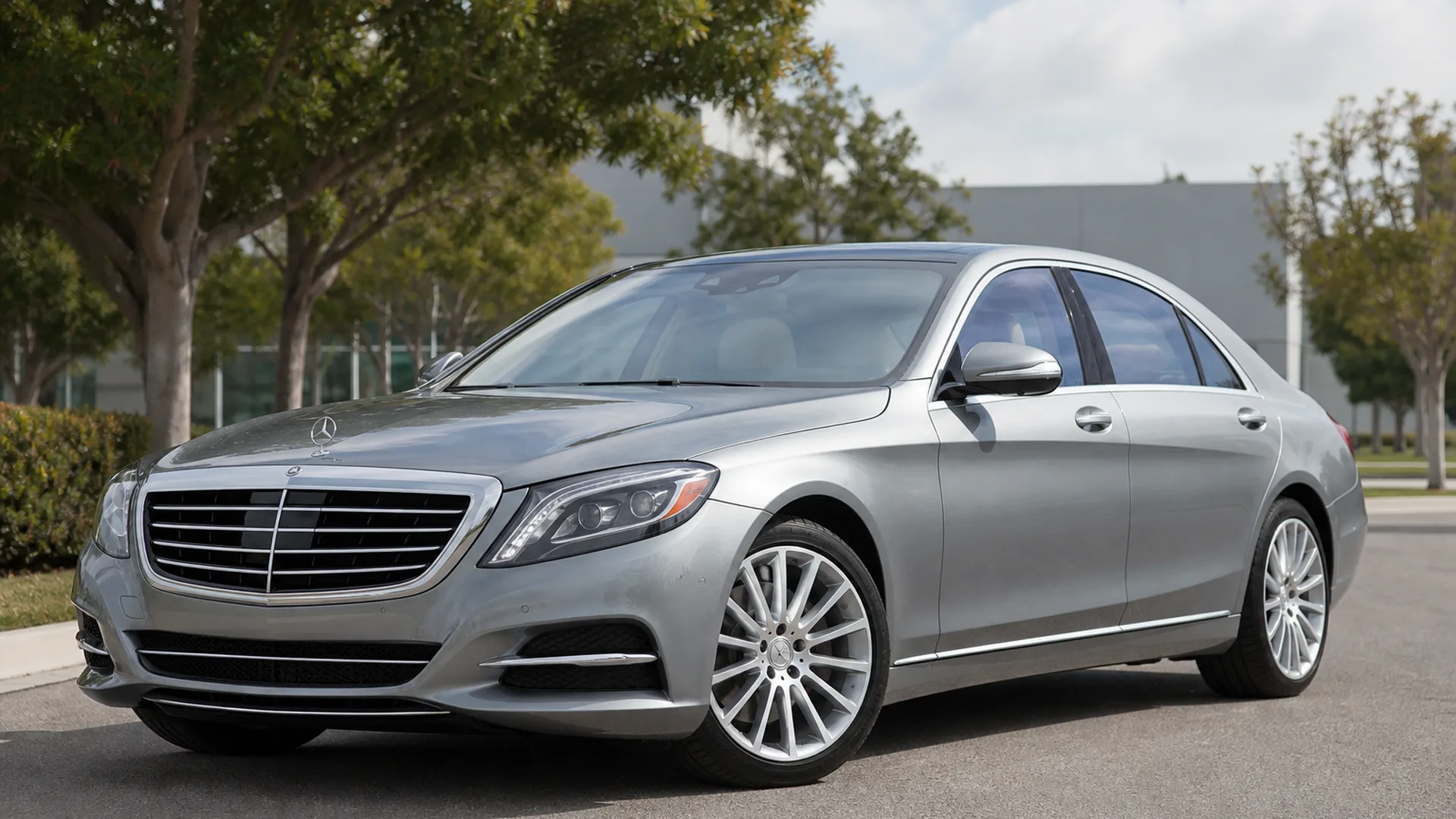
The Mercedes S550 represents the peak of German engineering—a luxury sedan that delivers twin-turbo power, adaptive air suspension, and enough tech to make a fighter jet jealous. When everything works, you’re floating down the highway in what feels like a private jet on wheels.
But here’s the catch: certain S550 years hide expensive problems that can drain your wallet faster than you can say “AIRMATIC compressor.” We’re talking timing gear failures that destroy engines, transmissions that slip into limp mode, and air suspensions that cost $6,000 to rebuild.
This guide reveals exactly which Mercedes S550 years you should avoid, which ones are safe bets, and what alternatives might save you thousands in repair bills.
How We Built This Research
Our team pulled data from multiple authoritative sources to give you the clearest picture of S550 reliability:
We analyzed NHTSA complaint databases to identify the years with the highest failure rates, cross-referenced owner reports from CarComplaints and BenzWorld forums, and studied recall records and class-action lawsuit settlements (particularly the M273 timing gear defect). We also consulted Mercedes specialist mechanics who see these cars in the shop daily, reviewed Consumer Reports and JD Power long-term reliability rankings, and compared cost-to-own projections across three S550 generations: W220, W221, and W222. Every recommendation here is backed by real-world data, not marketing hype.
What Usually Breaks on an S550
Before we talk about specific years, you need to know what tends to fail. The S550 packs incredible technology, but that complexity creates predictable weak spots.
1. The Engine Drama
Early W221 models (especially 2007) suffer from a timing gear defect in the M273 V8. The cam timing idler gear’s teeth can wear down, causing timing chain slip that leads to catastrophic engine damage. Mercedes eventually settled a class-action lawsuit over this issue, but 2007 models remain risky unless the gear was replaced proactively. Beyond that, valve cover gaskets leak oil, camshaft adjuster solenoids fail, and crankshaft sensors trigger check-engine lights. If you ignore warning lights, a small sensor problem can snowball into a $10,000 engine rebuild.
2. Transmission Headaches
The 7-speed automatic (722.9) has a weak spot: the conductor plate and valve body. When it fails—and it does, especially in 2007–2009 models—your transmission shifts hard, refuses to engage gears, or drops into limp mode. CarComplaints lists transmission problems as the number one complaint category for the S550. Replacing the conductor plate isn’t cheap, often running $2,500–$4,000 with labor. Later models got software updates and improved parts, but any used S550 should shift smoothly during a test drive.
3. Electronics Gone Wild
The S550 runs on dozens of electronic modules, and any one of them can glitch. A common culprit is the auxiliary battery—the second battery that powers electronics. When it weakens (typically after 7+ years or 100,000 miles), you’ll see random error messages, a malfunctioning electronic shifter, or total system shutdowns. The COMAND infotainment system is another trouble spot. A failed amplifier in the trunk can kill all audio or drain the battery while parked. Window regulators fail, door control modules die, and radar sensors for driver-assist features stop working. Diagnosing electrical problems is expensive because technicians chase ghosts through complex wiring.
4. Suspension That Sags
AIRMATIC air suspension gives the S550 its magic-carpet ride, but air springs leak, compressors wear out, and level sensors fail. After 100,000 miles (or sooner in harsh climates), you’ll see “Vehicle Too Low” warnings, uneven ride height, or a rear end that droops overnight. Air suspension repairs range from $2,000 for a single air spring to $6,000 for a full system overhaul. Some models also have hydraulic Active Body Control, which adds another layer of complexity. Check for leaks and listen for compressor noise before buying any used S550.
5. Climate Control Failures
The A/C blower motor is notorious for quitting due to moisture intrusion. One day it works intermittently, the next you’re driving with no heat or air conditioning. Mercedes issued technical service bulletins for this, and replacing the blower motor (plus its regulator) typically costs $800–$1,200. Other HVAC issues—like weak cooling or refrigerant leaks—are less common but still possible on older cars.
6. High-Tech Toys That Stop Working
Dynamic seats with massage functions use air bladders and pumps that leak or fail over time. Soft-close doors jam, power trunks stop responding, and night-vision cameras go dark. These features are luxurious when they work, but each repair costs hundreds of dollars. Test every gadget during a pre-purchase inspection—keyless entry, seat adjustments, trunk operation, camera systems—because fixing them later will hurt your budget.
The Two Years You Should Never Buy
2007 Mercedes S550 (W221)—The Nightmare Year
If there’s one S550 to avoid at all costs, it’s 2007. This was the first year of the W221 generation in the U.S., and it set records for owner complaints. The biggest problem? That timing gear defect in the M273 V8. If the idler gear’s teeth wear out, your engine timing goes haywire, and you’re looking at catastrophic failure. Mercedes fixed this in later years and settled a lawsuit, but 2007 models are ticking time bombs unless someone replaced the gear.
Beyond the engine, 2007 S550s also struggle with transmission conductor plate failures, AIRMATIC suspension leaks, COMAND system glitches, and A/C blower motor failures. Repair costs can easily hit $8,000–$15,000 for major engine or transmission work. One auto reviewer summed it up perfectly: “For the love of God, don’t buy a 2007 S550.” If you want a W221 S-Class, start your search at 2008 or newer.
2014 Mercedes S550 (W222)—First-Year Tech Issues
The 2014 model launched the W222 generation with a leap forward in technology—and a leap forward in complexity. First-year models suffered from software glitches, erratic driver assistance systems, malfunctioning sensors, and electronic hiccups that Mercedes later fixed via recalls and updates. Reddit owners warn that “the first year run of the W222 (2014) will be more prone to issues overall.”
Mercedes issued several recalls for 2014 S550s, including fixes for seatbelt anchors and ECU software updates. Problems weren’t as catastrophic as the 2007’s engine failures, but they were annoying and expensive to diagnose. If you find a 2014 S550 you love, make sure all recalls and software updates are complete before buying.
Other Years That Need Caution
2008–2011 S550: These W221 models improved over 2007, but aging components still cause trouble. Air suspension leaks, transmission electronics, and COMAND failures are common. Condition and maintenance history matter more than the specific year.
2015 S550: Some owners reported easily cracked alloy wheels and minor interior trim problems, but these issues weren’t widespread. Still, inspect the wheels and suspension carefully on any 2015 model.
In general, avoid the first model year of any generation and be cautious with older S-Classes that lack complete service records.
The Best S550 Years to Buy
If you’re set on a Mercedes S550, stick with years that have proven track records. Mercedes typically irons out bugs as each generation matures, so later model years are safer bets.
2012–2013 S550 (W221 Late-Model)
These final years of the 2007–2013 generation are the most refined W221 models. By 2012, Mercedes had updated the 7-speed transmission and installed the improved M273 V8 timing gear. Owner complaint data shows very low problem frequency in 2012–13 S550s. These cars still deliver all the luxury features of that generation, but with fewer headaches. If you want a W221 S-Class, a 2011, 2012, or 2013 model with documented service records is your safest choice.
2016–2017 S550 (W222 Pre-Facelift)
By 2016, the W222 S-Class had been on the market for a couple of years and received running improvements. Many owners call 2016–2017 the sweet spot for the S550. One Reddit discussion noted: “Shoot for a ’16 or newer. They have most of the bugs worked out.” These later S550s benefit from updated software and fewer electronic gremlins. Mercedes was about to facelift the S-Class in 2018 (when the S550 became the S560 with a new engine), so the last S550s often offer attractive used-car pricing. If you find a 2016–2017 S550 certified pre-owned with low miles, you’ll enjoy modern luxury with a lower risk of problems.
2018+ S-Class (S560 and Newer)
Technically not an S550, but worth considering: the 2018 S-Class refresh introduced the S560 with a 4.0L biturbo V8 that’s proven reliable so far. Reliability data for 2018–2020 S-Class models shows improvement, and some cars might still have remaining warranty coverage. They’re expensive, but they represent the pinnacle of that generation with all updates included. If your budget allows, jumping to an S560 or S450 from 2018+ could deliver an even better ownership experience.
The bottom line: buy the newest, lowest-mileage S550 you can afford from the end of its generation. A well-maintained 2013 or 2016–2017 S550 gives you S-Class luxury without the early-year headaches. Just make sure any car you consider has a thorough pre-purchase inspection and complete service records.
Alternatives That Might Save You Thousands
Luxury sedans offer plenty of choices beyond the S550. If you’re open to alternatives, these options deliver similar comfort with fewer repair bills or better warranties.
Lexus LS 460 / LS 500—Reliability Champion
If you prioritize peace of mind, the Lexus LS should be at the top of your list. The LS 460 (2007–2017) has a stellar reputation for durability. From 2013 onward, the LS 460 earned high reliability ratings and resolved most earlier issues. You won’t get the latest tech found in an S-Class, but you will get a plush ride and far fewer repair shop visits. The newer Lexus LS 500 (2018–present) introduced a twin-turbo V6 and modern styling while maintaining Lexus’s strengths in build quality and dealer support.
Recommendation: Look at a 2013–2017 Lexus LS 460 for a used buy (2013–2016 models are especially dependable), or a 2018+ LS 500 if you prefer something more contemporary. Lexus consistently tops reliability studies for luxury cars.
Genesis G90—Modern Luxury with Warranty
The Genesis G90 (2017–present) is Hyundai’s flagship sedan, offering S-Class-like features at a lower price with a better warranty. Every G90 comes with a 10-year/100,000-mile powertrain warranty and 5-year/60,000-mile bumper-to-bumper coverage—the longest in the industry. You can find a 2017 or 2018 G90 that might still have several years of factory warranty left, reducing ownership risk. Reliability has been strong; reviewers note the G90 has “spotless reliability” in long-term tests.
Recommendation: A 2017–2019 Genesis G90 gives you top-tier luxury amenities at a lower cost than a same-year S-Class, and you’ll enjoy the tail end of that generous warranty. It’s a compelling choice if you want comfort without European maintenance bills.
BMW 7 Series—Performance Option (With Caveats)
The BMW 7 Series is the S-Class’s rival, offering a more driver-focused experience. If you love driving dynamics and BMW’s style, a 7 Series could work. But be aware: BMW’s flagships have reliability challenges too. Older models (2000s E65/E66 and early 2010s F01) were notorious for electrical and suspension issues. The good news is that newer 7 Series models (2016 and later, chassis G11/G12) have shown improvement. A car-buying guide notes that 2017+ model years are more reliable than predecessors, with fewer reported issues.
Recommendation: Aim for the latest generation you can afford, ideally a 2017 or newer 740i/750i. Get a pre-purchase inspection and consider an extended warranty, because repair costs for a 7 Series match those of an S-Class. The BMW can be more fun to drive, but don’t expect it to save you money on upkeep.
Audi A8—Quattro Comfort
Audi’s A8 blends luxury with Quattro all-wheel drive, often at a slightly lower used price. The A8’s reliability falls between Lexus and German rivals—it has complex electronics and air suspension too. Common issues include timing chain wear and electrical glitches. If you consider an Audi A8, look at the 2015–2017 D4 generation or the latest 2019+ D5 generation, and find one with complete service records. The A8 is lovely to ride in, but like the S550, once out of warranty it can generate big repair bills.
Final Verdict: Buy Smart or Walk Away
The Mercedes S550 delivers flagship luxury when it works, but certain years hide expensive problems. Avoid 2007 and 2014 models at all costs—they’re the highest-risk years with engine failures, transmission issues, and electronic glitches. If you want an S550, stick with 2012–2013 or 2016–2017 models that have proven track records. Older W220 and early W221 cars may seem cheap, but repair costs will eat you alive.
If prestige matters most, buy the best-condition 2016–2017 S550 you can afford with a warranty. If reliability matters more, choose a Lexus LS or Genesis G90 and skip the European repair bills. Either way, budget $4,000–$6,000 per year for maintenance and repairs on any used S550—luxury only stays luxurious when you can afford to maintain it.
Money-Saving Tip: A used 2013 Lexus LS with 70,000 miles will cost less to maintain over five years than fixing one major failure on a 2007 S550. Sometimes the smartest luxury choice isn’t the one with the three-pointed star.